
CHURCH FENTON VILLAGE EVENTS (1958) film no: 2552
Download description pdf
Made by local filmmaker Frank Dean, this film captures scenes of village life in Church Fenton, a small village between Selby and Leeds, North Yorkshire. The film brings together four events in the Church Fenton area in 1958: a British Legion Sports Day, Sherburn Church Garden Fete, Church Fenton Village Hall Garden Fete and Kirk Fenton St Mary’s Sunday School’s Flower Service.
B&W
Title – Twelfth Annual British Legion Sports Day’ ‘Maj. R G Newall USA AF on Saturday August 23
A large tent has been set up in a field, and people are sitting around the tent and stalls. The Major is introduced by a local dignitary who makes an address to the people gathered for the event. Next there is a children’s fancy dress parade, including a sailor, a Red Indian and Little Bow Peep, with the Major watching the parade. He is accompanied by a woman holding a bouquet of flowers, and there is a table with home grown prize vegetables.
Title – Sherburn Church Garden Fete
A vicar and other local dignitaries address a group of adults and children that have gathered in a large garden. All the elements of a traditional English Fete are shown as women server from the tables laden with cakes and crafts. There is a young woman dressed as a Queen, with a retinue of girls and a boy. They stand in front of a group of small girls and boys holding placards with ‘Church restoration’ written on them. The Queen makes her way through the people, many with prams, and sits on her throne where she is presented with flowers by a young girl who also gives gifts to the retinue. The Queen then performs a mock ceremony, crowning the young children, and the vicar leads a round of applause.
Colour
Title – Church Fenton Village Hall Garden Fete
A crowd stands outside the village hall, and in the gardens there are stalls with cakes, and people arriving pay to enter. At the fete, there are many stalls, and two women can be seen eating toffee apples. There are also games including bingo.
Title – Sunday School flower service 1958
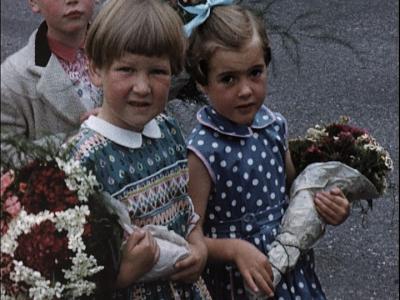
People have gathered on a small green in the village, and children are dressed up holding flowers and posing for the camera. A group of adults make their way off whilst the rest make a procession. They carry a banner for Kirk Fenton St Mary’s Sunday School at the front of the parade. The procession then heads off for the church, and we then see them leaving again. The film ends with a closing look at the church.
Download context pdf
This film was made by railway enthusiast and filmmaker Frank Dean. Frank spent most of his working life as a Signal Engineer with British Railways (becoming British Rail in 1965), until his retirement in 1982. With the disclosures of the Beeching Report proposing large scale closures of railway lines, Frank started a career of making films of the railway from 1963 until the present day (2009) – see A Sentimental Journey and the Context for this. The year this film was made, in 1958, was unhappily a bad year for Frank: both his step parents died, and Frank subsequently became very ill. In fact he had to sell the 16mm cine camera that he made this film with, and which he had for under two years, in order to pay the costs of the funerals; reverting to 8 mm and super 8 film from then on.
His interest in film got off the ground at an early age when a wealthy uncle in Leeds bought him a 35mm projector – at the time Frank was unaware of the combustible dangers of nitrate film – and he got involved in doing slide projections at school, moving on to photography and 9.5 mm cine film before buying his first 8mm camera from John Saville and Sons, York, in 1953 (for £36). It wasn’t with the railways that Frank first began his passion for filming, however, but with local events. Frank’s first film was of the Cawood annual show in that year (the film was lent out and subsequently disappeared). He went on to film events in his home village of Church Fenton where Frank has lived since his adoption at the age of three months. From that year until this (2009) Frank has made a yearly film record of local events in Church Fenton, capturing not only the village wide events, but also births and marriages.
Frank has not only recorded village life for over fifty years, he has also been showing them each year in the Village Hall. Looking back to the first showing in 1956 Frank remembers a packed house of some 200 people on a hot August day, with two attendees passing out from the heat, and the excitement of villagers seeing themselves on the big screen – although at the time only 4 feet wide! These showings were also fund raising events, and they have raised thousands of pounds over the years to help upkeep the village church of of St. Mary the Virgin; a completely cruciform church with a relatively large a tower, dating back to the thirteenth century.
Frank has contributed on the history of Church Fenton on the village website (see References). Here it is noted that: ‘The name Church Fenton has evolved over the years, starting as Fentune in 963 to Fentun in the Doomsday book of 1086. Kirk Fenton is first mentioned [in] 1338 signifying the establishment of a church in the village.’ This is interesting given that the spelling of ‘Kirk’ derives from the Norse (Viking) era, survivals from which, apart from previous place names, were mostly eradicated as a result of the Norman conquest of 1066.
This film covers familiar events. The British Legion Sports Day persisted for some years before the once strong local branch faded. In all probability Maj. Newall of the USA Air force would have come from the RAF base at Church Fenton, during the Second World War home of the first RAF ‘Eagle’ Squadron of Volunteers (which appeared at the beginning of the film Pearl Harbour). In July 1959 the Station ceased to be for front line defence and switched to a base for training only (see References for more information on the airfield).
Frank has been involved in the local Church of St. Mary the Virgin since a child, and is even today (2009), still heavily involved in its maintenance and restoration – Frank’s wife, Heather, has been Church warden for some 35 years. In 1966 Frank made a film, An Act of Worship, of the entire process of raising funds, about £2,000, required for major restoration work, including of the roof and the bell tower. This shows the then Archbishop of York, Donald Coggan, the noted Hebrew scholar later to become Lord Coggan and Archbishop of Canterbury.
However, on this occasion it is the larger All Saints Church down the road at Sherburn-in-Elmet that is featured. Frank made a film about restoration work at this church also two years earlier in 1956. Nevertheless, the Church Fenton Village Hall Garden Fete would have probably been raising money for the local church. These garden fetes functioned both as social occasions and as a means to raise money for the church. This money was, and still is, in addition to that made from the weekly offerings and collections. Each year there would be the same attractions: Miss Holdgreaves’ cake stall, jam and beer competitions, and the vicar judging ‘the best ankle’ competition, something that brought much mirth and shows that irony isn’t a post-modern invention.
The Church Garden Fetes ended in the late 1990s, and so too has the Sunday School now come to an end. Sunday schools were extremely popular right through the 1950s and into the following decade, although they have now much declined. Sunday School processions were common in the 1950s, especially at Whitsun, and very well attended, as many films held by the YFA testify. A recent programme for BBC4 charted the history of the Sunday School, and concluded that children would often learn much better there, free from the usual constraints of school.
At that time the cliché of a ‘tightly knit community’ was a reality: everyone in the village really did know everyone else, and neighbours would frequently pop in to see each other. For Frank the whole was ultimately based upon friendship. Although the village spirit and use of the village Hall declined with the building of new houses, Frank notes that this has recently made a turn for the better. Frank put at least some of the blame of the decline in village social life down to the coming of the TV. However, he also notes that in one respect at least there has been improvement: there is now a much closer union between the Church and the Methodist chapel.
After his retirement Frank got involved with the local school, teaching children railway history and giving them historical tours of the village. Again, Frank kept a historical record of the school activities on film, which he was able to sell to parents, raising money for the school. Unfortunately this had to come to a stop in 2003 when filming in schools was banned. Frank has been at the centre of community life in Church Fenton for over fifty years, and this was acknowledged in an 80th birthday party thrown in his honour at the Village Hall in 2005, at which a plaque was unveiled commemorating Frank’s huge contribution to the village.
References
Much of the information for this has come from two extended interviews with Frank Dean, recordings of which are held with the YFA.
Norman Davies, The Isles: A History, Papermac, 2000
Duration:
5 mins 39 secs of 14 mins |
 16mm |
 B&W;/Colour |
 Silent |
This film is an extract. To access the complete film please contact the Yorkshire Film Archive
Explore More
Discover more films from the YFA collections...



0 Comments
Post new comment