
WINKY CAUSES A SMALL-POX PANIC (1914) film no: 2234
Download description pdf
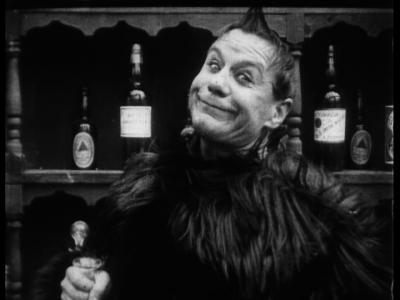
This is one of a number of films featuring a comic character called Winky – starring Regie Switz, a personality mime actor who made over fifty Winky films – who in this film causes panic when he dresses up as a bear. The film was made by Bamforth and Company of Holmfirth.
The film begins with Winky opening a box on the pavement with a wall and broken gate behind him. He pulls out a bear costume from the box, holds it up whilst pointing to himself and grins to the camera. He emerges from behind the broken gate wearing the costume and walks off down the road. Arriving at a grand house Winky goes into the drawing room and panics an elderly man with a hearing aid. The man runs out of the house and sees a large group of police who happen to be marching past. He gets the police to go into the house, but they soon re-emerge falling over themselves and run off chased by the bear.
Winky then enters a pub and goes up to the bar while three men chat at a table in the foreground oblivious to his presence. Winky get a tray of beers off the barmaid and takes them over to the three men. At this point they run off and Winky drinks the beers, rubbing his stomach in contentment. He then appears behind the bar swigging from a bottle and grinning and winking at the camera. On leaving the pub drunk he is caught and dragged off by police.
[The title is puzzling as although smallpox was rife at the time, it is not carried by animals – this might not have been known at the time.]
Download context pdf
This film is one of around 20 plus surviving films made by the Bamforth Company of Holmfirth, with copies held by the YFA. James Bamforth was one of a small group of early British filmmakers, along with Cecil Hepworth, George Albert Smith, and Robert Paul, and the first to take the music hall tradition into film. Their filmmaking falls into two distinct two year periods: the first from 1898 to 1900 (possibly extending to 1903), separated by a period of producing just postcards, and the second from 1913 until 1915, curtailed by the First World War (perhaps because the material used to make film was needed to make explosives). Others from the later period include the 1915 Sharps And Flats, and Jessie from 1914. For more on the early years of Bamforth see the Context for Kiss in The Tunnel (1899). The BBC made a comedy docudrama on Bamforth called Hollywood Holmfirth in 2006.
As well as actuality films, the first period also had comedy shorts, like Weary Willie (1898), about a tramp driving off people from a park bench so that he can sleep on it. This was based on a character originally created by the cartoonist Tom Browne for the magazine Illustrated Chips in 1896. These earlier comedies were usually shorter than those of the later period, although as with this one, not always so. Following in the footsteps of other film producers at that time Bamforth and Co. took on a music hall comedian, Reginald Switz, who had already developed the character of 'Winky'. In all, according to the IMD, Reginald Switz starred in 54 productions for Bamforth between May 1914 and May 1915, mostly as the mischievous Winky, with all those from 1914 having ‘Winky’ in the title – the BFI lists 37 of these, the IMD 40; among those not on the BFI list being How Winky Whacked the Germans (1914). In 1915 he continued to play Winky, as in Oh My (1915). Yet even when Reginald Switz didn’t play Winky, his character is invariably up to no good, as in Sharps and Flats (1914).
Their studios were enlarged in 1914 and as well as ‘Winky’ there were also marionette films (“Mario-Cartoons”) based on the drawings of A K Hazeldon of the Daily Mirror. At first they were making exclusively comedies, taking on new actors for comic roles including Lily Ward, Alf Scottie and the child star Baby Langley, who were all also music hall stars. Later on their films were being handled by the Yorkshire Cine Company which also dealt with Pyramid Films who had taken over the studios at Towers Hall Bradford towards the end of 1915 from Captain Kettle Films (Low, p. 101) – another local rival at that time were the Captain Kettle Film Co., also of Bradford. This takeover led to a change of name on 15th October 1915 when they registered as Holmfirth Producing Company with a capital £7,500 in £1 shares. This gave a new impetus to making longer narrative films. Most of these films, including all the Winky ones, were produced and directed by Cecil Birch. The IMD only lists his films from the 1914 – 1916 period, whereas a glance through Gifford will show that he was making many films from the turn of the century.
Among the films made between 1913-1915 that have survived are: Counterpart (1913), Itching Powder (1914), The Mighty Atom (1914), Winky And The 'Dwarf' (1914), Winky's Weekend (1914), The Mystic Glove (1914), Winky's Rose (1914), Scottie And The Frogs (1915), and Sharps And Flats (1915).
Bamforth were only one of a number of film companies making comedies at this time. Companies were springing up everywhere, especially in the suburbs of London. Duncan Petrie states that from around 1913 film producers like Cecil Hepworth, William Barker and Ralph Judd’s London Film Company were beginning to make longer narrative films. This was not a route Bamforth took, apart perhaps from their film Paula of 1915 (Low erroneously has this 1916), which may have prefigured a departure for them had they continued to make films (this was loaned out to someone in Russia at the time and hasn’t turned up since). Both Petrie and Low argue that the Hepworth Company stood out in their development of the aesthetic side of cinematography.
A wide range of films were being made prior to the onset of war; cinema showings consisted of many short varied films. These films would tour the country and abroad, with films coming in from the US, France and Italy – although Bamforth had also established their own local cinema in Holmfirth. Comedies were prominent on film showings. John Montgomery lists seven types of comedy films being made in 1915: the ‘chase comedy’; the trick photography film; the knockabout, or slapstick, picture; the dramatic farce; the domestic or social comedy; the satirical comedy and the cartoon film, which the French specialised in (Montgomery, p 74). Among the forerunners in Britain was the EcKo Film Company, who also used music hall comedians, such as Lupino Lane. They encouraged their music hall comedians to use new material and not just repeat their old acts. Cecil Hepworth became known for his one reel 'Tubby' comedies, ‘The Exploits Of Tubby’, with John Butt. But Wendy White claims that, “the most famous and enduring film comic in Britain at the time was Fred Evans' Pimple”, who with his brother Joe set up Folly Films, and together they proceeded to satirise the issues of the day, as well as other contemporary plays and films.
The storylines of comedies at this time were really just vehicles for gags, so film companies wouldn’t be overly concerned about scientific accuracy. Presumably at the time this film was made knowledge of whether animals could transmit smallpox was limited. In fact at the time smallpox had become much rarer, thanks to Edward Jenner’s discovery of the virus and vaccination in 1796, and the introduction of compulsory smallpox vaccination in Britain in 1853. Nevertheless, it remained a topical issue, with it arriving often by ship from countries where it was still rife. In 1908 Dr Ricketts published his influential Diagnosis of Smallpox. There was in fact a major outbreak in Bradford in 1962. It is estimated that during the 20th century smallpox was responsible for 300–500 million deaths, and it was not until 1979 that the WHO declared that smallpox had been eradicated.
References
Robert Benfield, Bijou Kinema, A History of Cinema in Yorkshire, Sheffield City Polytechnic, 1976.
Denis Gifford, The British film catalogue, 3rd edition, Fitzroy Dearborn, 2001
Racheal Low, History of British Film, 1896 – 1906, Vol. 1, Routledge 1997 (1948).
Stephen Herbert and Luke McKernan, Who's Who of Victorian Cinema (London: BFI Publishing, 1996)
Duncan Petrie, The British Cinematographer, British Film Institute, London, 1996
Allan Sutherland, 'The Yorkshire Pioneers', Sight and Sound, Winter 1976-7, pp. 48-51 Issue 187 - Vol 46 No. 1 1977
Duration:
2 mins |
 35mm |
 Silent |
 Black & White |
Explore More
Discover more films from the YFA collections...



0 Comments
Post new comment