
STILLINGTON, YORK, AND EASINGWOLD (1931-1942) film no: 2170
Download description pdf
This film is a compilation of people, places and events in 1936 and 1942. It covers the choir at York Minster School, repair work taking place at York Minster, Worksop College, erecting electricity pylons in Stillington, and National Prayer day in Stillington in 1942.
The film begins with workmen sawing timber into logs, before going on to show a line of boys in caps going into the Minster. Several men emerge from the Minster, one man poses for the camera, doffing his hat. Later, when there is snow on the ground, a group of boys walk across the grounds of the Minster School. They are followed by more men who pose for the camera. In no particular order, these are reported to be: Master Holman, Marton Church, Minster Choristers, Mr Dean Owen P LeFranklin (organist), the Headmaster G.A. Scaife (elderly man with scarfe – no pun intended) and the Master Organist Sir Edward Bairstow (with pipe).
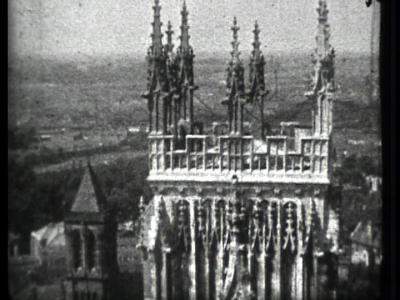
Renovation work is taking place at York Minster. Stone masons are using drills, saws, and chisels to shape the stone. From on top of one of the Minster towers, the film shows wooden scaffolding around the Minster as well as a view of the city. A man climbs up a ladder to one of the towers where there is a bell. Other workmen are working up on the towers, and two men descend down a lift. From the top of a tower and looking down, the stone can be seen laid out in the yard. Some of this stone is pulled to the top of the tower using pulleys.
There is a brief scene of a cricket match followed by a view of Worksop College from the front, including the College Chapel. Some churchmen stand in the doorway.
The film switches again to a field where workmen erect a timber electricity pylon using ladders as props. Reportedly this is in 1936 in the area of Stillington, Sheriff Hutton, and Marton. A lorry arrives pulling cables across a field to another pole. From on top of a pole, a workman can be seen standing below next to a brazier. He then climbs up a ladder, which is leaning against the electricity pole, to pass on an electrical component. One of the workmen is struggling in the wind. He is trying to hold down a map resting on the bonnet of a car. More poles are unloaded from the lorry and erected in the rain.
The final portion of the film features a group of scouts making a fire – reportedly the 1st Stillington Scout Troop on a patrol camp at Lion Lodge, Yearsley in York in 1942. A group of scouts peel potatoes, and two scouts row a boat. This is followed by another group of scouts hoisting a Union Jack flag in the yard of the Boys Club in Stillington. Next, during a day of National Prayer, the local church officials lead a church parade through the streets of Stillington. In the procession, they are followed by the Scouts and the Home Guard. Many of the villagers walk along by the sides of the parade. They make their way into Stillington Church, and the scouts lower the Union Jack flag before they march away.
Download context pdf
This film was made by Mr G F (‘Freddy’) Baker, an amateur filmmaker and electrician who owned an electrical shop in Malton, and lived in Easingwold from 1930. The films were passed on to a work colleague, Noel Foster, then to Noel’s son Paul Foster, and then on to Don Brown when he was organising centenary celebrations in Stillington in 2000. The YFA has three short films made by Foster of Stillington and other parts of North Yorkshire, although there may be others that have not come to light. Another of Freddy Baker’s films of Stillington made around the same time also features a cricket match, the Scouts, a tree being planted to commemorate the coronation of George VI in 1937, and film of the Rev. W. Smith – who may also be in this film. Freddy compiled some notes on the films which name some of the locals that appear. They were all filmed using 9.5 mm film, which was fairly popular at the time, being significantly cheaper than 16mm. This gauge was developed in 1922 by Pathé, and lasted into the early 1960s when it was finally superseded by 8mm and Super 8. YFA Online has other films featuring the Scouts and the Home Guard, see New Horizons (1952)and Formation Of The Homeguard (1944).
Local historian Grahame Richardson has provided names for some of those who can be seen on the patrol camp at Lion Lodge, Yearsley in York in 1942: Bill North, Harry Manson and Bill Hugill. He also notes that the Church parade would have taken place on the day of National Prayer, 3rd September 1942. Among those marching down Main Street from the Green to Stillington Church – two of the three women at the rear – are Mrs Maskell and Mrs Newman.
Perhaps Stillington’s greatest claim to fame is being the home of the renowned eighteenth century author Laurence Sterne, of Tristam Shandy fame. Although born in Ireland, Sterne had a Yorkshire heritage with his great-grandfather on his father’s side, Richard Sterne, being the 72nd Archbishop of York from 1664 to 1683; his grandfather was squire of Woodhouse near Halifax and his grandmother inherited Elvington Hall near York. Sterne was vicar of Sutton, just a mile up the road, from 1741 before taking on the ‘living’ at Stillington in March 1744 following the death of the vicar Richard Musgrove – a ‘living’ was the term for a clerical post. In fact Sterne kept his position at Sutton, hence having more than one living, which, although restricted, was not uncommon at the time. He duly served both parishes for twenty years. Sterne became friends with local squire Stephen Croft (of the Croft Port family).
Apparently the locals found Sterne (not surprisingly) somewhat eccentric, although the parish thrived whilst he was there (see Cash). During this time Sterne became prebendary of York Cathedral and preached throughout the Vale of York and East Riding. Sterne left Stillington in 1760 to become vicar at Coxwold near the edge of the North Yorkshire Moors (see Coxwold Gymkhana). This whole area, and some of the characters who lived there, found its way into Sterne’s marvellous Tristram Shandy. In his The Spell of Yorkshire (p. 162) , Walters, who doesn’t give a high opinion of Sterne, claims that, “Tristram Shandy must be regarded as Yorkshire in its inspiration, its atmosphere, and its texture.” An interesting potted history of Stillington written by Alan Kirkwoodcan be found on the village website (see References)
The work being done to York Minster was the result of Dean Lionel Ford announcing in 1930 the need for repairs to the central tower, choir, nave roofs, and those windows not repaired in the previous decade. The costs were estimated (rather exactly) as £52,236: a sum that seems remarkably low today – but this was a time of severe economic depression. The Friends of York Minster was formed in May 1928, growing to 1,412 members in four years and helping to raise £12,427 by 1930. Further money was raised through the sale of land (see the chapter by Reginald Cant in Cant and Aylmer, References). The restoration, including the re-roofing in copper and rebuilding the wooden ceiling, wasn’t completed until 1951. Since then there have been several other (successful) appeals and more major work, with the Cathedral clad in scaffolding as often as not.
The Minster School is of much more recent origin than the Minster itself, although boy choristers have sung there from the seventh century. John Roden dates the school as an institution back to the fourteenth century, but the history of the present school ties in with that of St Peter’s school which occupied the Pritchett building in Minster Yard from 1833, before moving out to Clifton in 1844, having amalgamated with Clifton Proprietary School. It was here that the choristers were educated, and in all probability remained so, in part, up until the present singing school was founded there in 1903 (prompted by the 1902 Education Act). Amazingly, in its first hundred years the school has had only four headmasters, and the one seen in the film, George Arthur Scaife, was headmaster from 1903 until 1951.
A former teacher at the school, John Roden, gives a full account of the school during this time with extracts from the memoirs of former choristers, including that of Francis Jackson, who finished at the school shortly before this film was made and went on to become an eminent organist and composer (see References). Another former pupil quoted by Roden is Humphrey Hill, who may be one of the boys seen in the film. The accounts paint vivid pictures of both George Arthur Scaife and Sir Edward Bairstow. From these Scaife emerges as a likeable teacher still in the Victorian mould; and Bairstow as being extremely strict, yet inspirational. The school curriculum remained essentially unchanged throughout Scaife’s time. Both he and Sir Edward Bairstow can be seen pictured together in 1941 in Roden.
The film of the wooden electricity poles being put up shows an interesting aspect of that time in the mid 1930s. According to Grahame Richardson, the electricity poles and transformer are being erected in Marton, connecting the vicarage, and Marton Church can also be seen in the background. Graham also suggests that it might be the maker of the film, Freddy Baker, who is leaning on the car during this part of the film.
Up until the First World War the supply of electricity was very haphazard and limited: with some 600 separate small electricity producers across the country. In 1915 the government set up the Electric Power Supply Committee which recommended appointing electricity commissions to divide the country into district boards. This was followed up in 1919 by theElectricity (Supply) Act which created joint electricity authorities that could acquire all the power stations in their area, build new ones and interconnect the network across the country. On the basis of a Report by Lord Weir, the Electricity Supply Act of 1926 then set up the Central Electricity Board (CEB), which established the National Grid, although this wasn’t completed until 1933 – when a third of houses had electricity – and didn’t come into full commercial operation until 1935 (and not fully integrated until 1938). Before this Act there were numerous independent providers, with capacity far in excess of maximum demand; an inefficient situation that pushed up prices.
It was Scotland that led the way with Edinburgh erecting the first pylon in 1928. The rather rudimentary methods of erecting the timber pylons seen in the film demonstrates just how much the national grid was still at a primitive stage. Although supply was driven initially by the need for lighting, by 1936 some 80% of electricity generated was going to industry: the assisted Wiring Scheme, began in 1930 by local authorities to supply domestic users, had only reached 12,000 premises by the time this film was made in 1936, the year that the Electricity Supply (Meters) Act was passed.
There was much opposition to the construction of pylons across the countryside: the government had to conduct a concerted campaign to promote electrification, stressing that it was integral to modernisation. Not surprisingly the large steel pylons were regarded as unsightly – which, believe it or not, were designed, by Sir Reginald Bloomfield, not to be positively ugly. Yet, out of the 22,000 property owners directly affected, only 600 required compulsory orders. The government were helped by the fact that by the 1930s many of the domestic electrical items we are used to today were already in existence: cookers, heaters, vacuum cleaners, fridges, teamakers, radios, kettles, irons, washing machines and even ‘wakers’, which pulled off the bedclothes when the alarm went off!
However, the electrical industry wasn’t nationalised until 1948 when the Central Electricity Generating Board (CEGB) was set up – the National Grid was re-privatised in 1990. There is no real argument today over the need for electricity, just how to keep the need down and how to generate it without adding to greenhouse gases and other harmful environmental effects – which might make the rural landscape seen here very different in the future.
(With special thanks to Grahame Richardson who has supplied detailed notes for this and other films made by Freddy Baker)
References
Anthony Byers, The Willing Servants: A History of electricity in the home, Electricity Council, 1988.
Reginald Cant and G E Aylmer, A History of York Minster, Clarendon Press, Oxford, 1977.
Arthur Cash, Laurence Sterne: The Early and Middle Years, Methuen, London, 1975.
Rob Cochrane, Power to the People: History of the Electricity Grid, Littlehampton Book Services, 1985
LeoEnticknap, Moving Image Technology: from zoetrope to digital, Wallflower Press, London, 2005
John Roden, The Minster School York: A Centenary History 1903-2004, SACRAM Publishing, York,
Ian Campbell Ross, , Laurence Sterne: a life, Oxford, 2001.
J Cumming Walters, The Spell of Yorkshire, Methuen, London, 1931.
Duration:
11 mins 6 secs |
 9.5mm |
 Silent |
 Black & White |
Explore More
Discover more films from the YFA collections...



1 Comment
Some years ago, around 2004, Don Brown let me have a video of the film that Freddie Baker had made in the 1930's. When Don was given the film by Noel Foster it was in bits and pieces and some had been reassembled using some "glue" and the sprocket holes were not aligned. Don had to re-assemble it as best he could. Indeed he had to manufacture some equipment to cope with the sockets. He showed it at our Village Hall and I believe that it was at this stage it came to the attention of Binnie Baker of the Yorkshire Film Archive, who was a friend of Don's daughter, who put it onto video.
Over many months between 2004 and 2009 I hosted tea parties in my house at which local villagers who were on the film as young children or whose parents were on the film. It was these villagers, one of whom was Don Brown's wife, who commented that the film had been assembled in the wrong chronological order. I paid to have it put onto a DVD by a local professional firm and had another series of "tea parties" to establish the correct order of events.
Over a period of time I have been in contact with Mr. Young the archivist at York Minster Library who has helped me with the names of some of those people appearing on that bit of the film relating to York Minster. Finally as I went to Worksop College I was able to get details of some of those persons on that part of the film relating to the College, from the Secretary of the Alumni of the Old Worksopian Society.
I have attached the above notes as a Word document (best to right click on it and open in new window).
Please do accept the next comments as being helpful and in no way critical. In the Context you state that Freddie Baker had a shop in Malton. I was not aware of this. His shop was in the Square at Easingwold and until 2 years ago was carried on under his name as an electricians/Tv/wireless.
Post new comment