
A SCRAP OF PAPER (1914-1918) film no: 1142
Download description pdf
This film, made by Debenham & Co. of York, was made in order to raise money for the dependents of war casualties as well as soldiers disabled during the conflicts of World War I. It features a mixture of drama and actuality footage.
Title – A Scrap of Paper. Filmed by Debenham & Co. York.
A crowd of adults and children line the street. They wave at the soldiers as they march by. In the background there is a large advertisement for ‘Theatre De Luxe.’
Title – There’s my Daddy!
A mother and her children cry and wave hankies as the father passes by. There is another brief shot of the marching soldiers.
Title – Scene. Somewhere in France. Before going over the top, His last thoughts are of home.
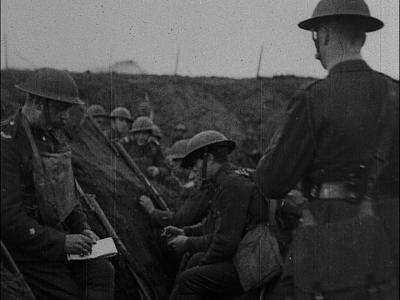
Now in the trenches of France, the soldiers are gathered. Most are smoking, and some write letters home. There is a close-up of a man writing a letter which reads, ‘Dear little Woman, I hope you and the kiddies are ‘top hole.’ Yours truly A.I.’
An officer appears and announces, ‘Be Ready. In ten minute’s time we attack.’ One man finishes his letter to his wife before the men attack. The letter reads: Well, I have only a few minutes to write these lines as we are about to attack. Don’t worry dear, we shall pull through – if we don’t – I am happy in the thought that those at home in good old Hull will do their duty even as I am endeavouring to do mine, and will look after and care for you dear ones. Your ever loving husband, Tom.
Then, with rifles in hand, the men emerge from the trench and run to attack the enemy. A body is seen lying just outside the trench.
Titles – That Scrap of Paper. How Hull Will Keep Faith. The City of Hull Great War Trust is endeavouring to raise £500,000. The money will be utilised in helping the Dependents of the men who made the Great Sacrifice & for those who have been disabled. Over 7,000 Hull men were killed and 14,000 disabled. On Friday Oct’ 31st A Special Matinee will be given at this theatre, the entire proceeds will be given to this fund. That Scrap of Paper will be honoured. You will come to this performance By so doing you will assist the ‘Great War Fund’ and at the same time spend an enjoyable afternoon.
Download context pdf
This film has something of a unique place in the Yorkshire Film Archive as it is possibly the only film in the collection that was made specifically to raise money for the dependents of war casualties. The YFA has films made during the Second World War aimed at raising money, such ‘Wings for Victory’ and ‘Salute the Soldier’, but these were produced to raise money for the war effort, not for those who have suffered as a result of the war.
This film has something of a unique place in the Yorkshire Film Archive as it is possibly the only film in the collection that was made specifically to raise money for the dependents of war casualties. The YFA has films made during the Second World War aimed at raising money, such ‘Wings for Victory’ and ‘Salute the Soldier’, but these were produced to raise money for the war effort, not for those who have suffered as a result of the war. The War Office put out regular films, but these were either propaganda films, or appeals to aid the war effort, such as contributing to the War Loan. The other major filmmaker at the time, Pathe, made films that are mainly documentary in character. Indeed, within the vast amount written on the ‘Great War’, only a very small proportion concerns itself with those left behind to live through its consequences.
In line with this marginal status, the film arrived with no information about who commissioned the film or how it came to be made – or even when it was made. All we have to go on is in the film itself. The figure of 7,000 Hull men killed in the war provides a clue: that it was made late on in the war, yet clearly when the war was still being waged: with scenes of soldiers writing home. In fact an amazing postal system did operate between the front line and home, with thousands of letters going each way daily between soldiers and their loved ones. Although this must have been a comfort for the families, soldiers usually wouldn’t tell of the real horrors they experienced.
The Company who made the film, Debenhams & Co., made at least one other film concerning World War One, Farewell Send-Off To The Darton Recruits, in 1915, held at the Imperial War Museum. This records the festive departure to war of soldiers recruited from the colliery town of Darton, Yorkshire, featuring the band of the 1st Battalion York and Lancaster Regiment. The YFA has a number of films made by Debenhams & Co. online, including King George And Queen Visit Hull (1941) – the Context for this film has more information on Debenhams.
The film is a simple one: with short episodes of actual film of soldiers marching, interspersed with staged scenes of a mother and her children – with a boy, apparently, not entirely acting according to the scene! – and of soldiers in the trenches. The film has to tread a thin line between not being too graphic, which might be demoralising, and yet being realistic enough to elicit sympathy.
During the First World War the system of recording and commemorating the war dead was formalised by the creation of the Imperial (now Commonwealth) War Graves Commission (CWGC). The war finally came to an end on Armistice Day, 11th November 1918. There were certainly a great many families that were terribly affected by war. Estimates of British casualties during the war are not definitive, but the figures are usually put at around at 703,000 killed and 1.6 million injured. This figure is raised significantly if all commonwealth countries are included. The death rate comes out as 35.8% of all those mobilised – a figure that compares with 76.3% of Russians who were mobilised.
Although the government did give allowances to dependents these did not keep up with inflation, and they tended to leave it to charities and voluntary organisations to meet this need. This was made worse by the fact that the government passed an act in 1919 to restore pre-war practices, i.e. to give men their jobs back. This was also favoured by trade unions, especially those representing skilled workers who fell behind relative to unskilled workers. The de-regulation of the wartime economy in the immediate aftermath of the war led to massive unemployment and major political upheaval, with large numbers of workers being inspired by the example of the Russian revolution, and the ugly spectacle of attacks on black maritime workers who managed to get work in the scramble for jobs.
It was during the First World War that the poppy became a symbol for those killed on the battlefield, when at Ypres in 1915, John McCrae, a surgeon in the Canadian Army, wrote the poem In Flanders Fields. The red poppy grows in disturbed earth and so come to symbolise those who died on the war-torn fields of Europe; where, undoubtedly, many a letter home, ‘a scrap of paper’, was left to blow in the wind.
References
Joanna Bourke, Dismembering the Male: Men’s bodies, Britain and the Great War, Reaktion, London, 1996.
Denis Winter, Death’s Men: Soldiers of the Great War, Penguin Books, 1979.
A database of war dead can be found also here.
The Long, Long Trail, a tribute to the men and women who died in the war.
Further Information:
David Bilton, Hull Pals, Pen and Sword Books, 1999.
Duration:
4 mins |
 35mm |
 Silent |
 Black & White |
Explore More
Discover more films from the YFA collections...



1 Comment
The card at 3:41 says 'On Friday Oct' 31st A Special Matinee will be given'. 31 October did not fall on a Friday in any of 1914, 1915, 1916, 1917 or 1918. But 31 October 1919 was a Friday. So I think this was actually released after the end of the war (though some or all of the footage may have been recycled from wartime films).
Post new comment