
BILLY LIAR ON LOCATION - LEEDS, BRADFORD (1962) film no: 1120
Download description pdf
Filmed in 1962, this film captures a behind the scenes look at part of the making of the John Schlesinger film, Billy Liar (1963). This film gives an interesting look at the production of Billy Liar as portions of the Leeds and Bradford location shoots have been documented on this film.
Billy Liar is the story of an undertaker’s clerk, Billy Fisher, who longs to escape his monotonous existence for the bright lights of London to become a scriptwriter. But his life is one long round of tightly knotted, but steadily fraying lies. Ever the dreamer, Billy weaves an ever-growing web of deceit as his outrageous fantasies spiral out of control. The film was shot on location in Yorkshire between October and December, 1962.
October, 1962: The film opens with soldiers marching in a parade led by a brass band. The parade passes in front of Leeds Town Hall. A few tanks bring up the end of the parade, and actors dressed as dignitaries are standing on the steps of Town Hall watching the procession pass by. Various crew and film equipment can be seen, and director John Schlesinger uses a blow horn to give instructions to the surrounding extras. He also instructs the actors on the steps of the City Hall. Further crewmembers set up a camera on a tripod outside the Town Hall to capture the scene from a different angle.
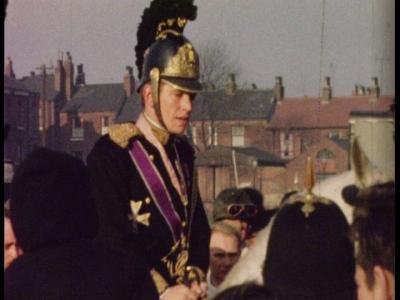
The next scene takes place in Bradford during the filming of one of Billy’s grand fantasy scenes. Billy, played by Tom Courtenay, is directly in front leading the large military parade. Some of the marchers carry a large banner. Surrounding the scene are different members of crew who work the tracking equipment necessary to get a tracking shot. Many extras have turned out for the shoot and are all dressed in military uniform. The majority of this portion of film focuses on the technical crew and the various cameras and other pieces of equipment required to make the movie.
Download context pdf
This filming of the production of the film Billy Liar was made by Leeds local cine enthusiast David Chapman. The film found its way to the YFA via Tony Earnshaw of the National Media Museum whilst he was working on a project on Bradford on Film, and which resulted in the book Made in Yorkshire (see References – David can be seen in the photograph on p.73 just to the left of the banner, two along from the policeman. But note that the caption for one of the photographs is in error in identifying Bradford, rather than Leeds). On hearing about this project through the Look North TV programme, David contacted Tony and dug this film out of the attic. One weekend, back in 1962, David had returned to Leeds to find the filming of Billy Liar almost on his doorstep, and rushed home to get his cine camera to film the production.
They actually filmed near his old school, Green Lane School, off Tom Road, where David lived, and this can be seen in the Billy Liar film. Seemingly unconcerned by David roaming around the set – being careful not to get in the way – the film crew carried on as usual and David was able to capture the filming. During the week David worked in York as a graphic arts photographer in printing. David had acquired a Kodak cine camera whilst still at school in 1955, shortly after this inexpensive cine came out (although he had a different camera by 1962). At the age of 22 David wanted to be a film cameraman himself, but like many others found it difficult to find a way in without contacts and from outside London. Over the next 10 years David took a lot of film of his family, but virtually all of it is outside Yorkshire. David was not a member of the Leeds Cine Club, and eventually found using 8mm film hard work – 16 mm being a lot more expensive.
The film provides a rare glimpse behind the scenes of a major film made in Yorkshire. The film was based on the novel of the same name by Leeds writer Keith Waterhouse, written in 1957. Waterhouse claimed that the film wasn’t autobiographical, even though he too had had a dead end job as a clerk at an undertaker's before escaping to Fleet Street. He went on to adapt it for the stage, and worked with Willis Hall, another Leeds man, on the screenplay for the film. Waterhouse went on to write some 20 novels and the same number of plays, as well as being an extraordinary prolific and highly regarded newspaper columnist with the Daily Mirror and the Daily Mail.
Although this excerpt of the filming of Billy Liar is shot in Leeds, most of the actual film was made in Bradford, and provides a fascinating glimpse of Bradford when it was at the height of its post-war transformation. In 1962 the Swan Arcade, where JB Priestley had his first job, was being demolished at the time this film was made. It was replaced by Arndale House, built by the corrupt building developer John Poulson. This rebuilding work can possibly be seen in the background in the film, and having this in may well have been deliberate on the part of the filmmakers. Keith Waterhouse was to later write about what he saw as the wanton destruction of city centres: “I would put most of the blame on the councillors who invite and encourage the laying-waste of their own townships. The trouble is that many of them are not very bright.” In 1962 John Betjeman described the growing structures of glass and concrete as ‘international nothingness’. See the Context for the film 700th Anniversary Of Bradford Market Charter (1951) for more on the re-building of Bradford.
The film is one of many made in Yorkshire (see the book Made In Yorkshire, which provides details and an excellent overview of these films, in References). John Schlesinger, seen directing in the film, later also made Yanks in nearby Keighley in 1978. Schlesinger won an Oscar for director of Midnight Cowboy in 1969, which also won best film.Tom Courtenay, who was born in Hull, featured in many films located in Yorkshire, including The Dresser, also partly filmed in Bradford at the Alhambra Theatre. This co-starred Albert Finney who had played the Tom Courtenay part, Billy Fisher, on stage, but turned down playing the part in the film. Having starred in The Loneliness of the Long Distance Runner the previous year, Billy Liar established Tom Courtenay, playing the lead character Billy Fisher, as a major actor.
The film also starred Julie Christie making her first major film role. Julie only took the role, of Liz, after the first choice, Topsy Jane, had to drop out because of illness. All the scenes she had appeared in had to be re-done. An interesting feature of this film is that it was made when they were shooting the original version: it is Topsy Jane and not Julie Christie who is with Tom Courtenay at the top of Leeds Town Hall steps – an early scene in the film. Playing entirely different kinds of characters, Tom Courtenay and Julie Christie also appeared together two years later in Dr Zhivago.
Both the novel and the film emerged out of post war 1950s Britain when a new generation of talented artists appeared. There was a movement in literature, the theatre and cinema towards examining working class life, and locating this more in the provinces – some came to be known as part of the ‘Movement’ with a capital ‘M’. Pioneering in this were Tony Richardson, Karel Reisz and Lindsay Anderson who, through a programme of screenings at the National Film Theatre between 1956 – 59, formed the Free Cinema movement, and along with John Schlesinger and Jack Clayton, the ‘British New Wave’. Although this was not entirely new – see Philip Gillett’s book (References) – it was distinctive in having a more youthful edge and in taking a less passive perspective. In Billy Liar this is represented by the character of Liz, who in the film escapes from Billy Fisher’s dead end world for London.
In the same year as Billy Liar came out, Colin Macinnes’ City of Spades and Room at the Top by John Braine were published, this last also featuring a working class character living in Yorkshire (Worley, modelled on Bradford). Two years later came David Storey’s This Sporting Life about a working class boy who becomes a professional rugby league footballer. Both of these were also turned into films and filmed in West Yorkshire – in 1958 and 1962 respectively. Later still came Kes, also filmed in the Bradford area in 1968 (see also the Context for Kindergarten). Two other films made in West Yorkshire and worth a mention in this context are Brassed Off (1995), and Rita, Sue and Bob Too!, filmed on the Buttershaw Estate in Bradford in 1986 – described by Tony Earnshaw and Jim Moran in their book as, ‘Thatcher’s Britain with her knickers down’.
Of course, each of this new generation had their own take on working class life at that time, but the four directors involved in these films – John Schlesinger, Lindsay Anderson and Ken Loach, and Jack Clayton (although Clayton is more eclectic) – were all prepared to push the boundaries of what could be shown in mainstream films. Many of the novels and films reflected a post war period when there were more educational opportunities for working class children, and this, together with new trends in youth culture, created a distance from the generation of their parents – Billy Liar has a comic scene that may well have inspired the ‘Four Yorkshiremen’ sketch from At Last the 1948 Show, and later Monty Python.
This was seen especially so in theatre with new playwrights, some tagged as ‘angry young men’ (a journalistic term taken from Leslie Allen Paul's autobiography of 1951). These included John Osborne with his pathbreaking Look Back in Anger – in that breakthrough year of 1956 – and Arnold Wesker with his classic Roots Trilogy. Here working class young men rebel against rigid authority and stifling outlooks. Even the character of Billy Fisher in Billy Liar rebels in his own fashion – as does another character played by Tom Courtenay, Colin Smith, in Alan Sillitoe’s The Loneliness of the Long Distance Runner,made into a film by Tony Richardson just before Billy Liar in 1962.
Billy Liar has been classed among a series of films made in the late 1950s and early 1960s as ‘kitchen sink dramas’: dramas that are viewed as being socially or morally realistic. These usually have a domestic setting – although the film The Kitchen (1961), directed by Yorkshireman James Hill of an Arnold Wesker play, is set in a hotel kitchen. It is interesting to set Billy Liar against another film made the year before, A Taste of Honey, adapted for film in 1961 by Tony Richardson from the play by Shelagh Delaney. This is perhaps the most challenging of the ‘kitchen sink dramas’. Like other films made by ‘New Wave’ directors, Billy Liar, with its stereotyped female characters, can be accused of a certain misogyny – although the male characters are equally stereotyped and Liz represents someone new and different. But A Taste of Honey goes beyond the issue of class to openly explore race, gender and sexual orientation at a time when few others were doing so. It went on to win four BAFTA film awards, best actor (Murray Melvin) and best actress (Rita Tushingham) at Cannes (1962), and Tony Richardson and Shelagh Delaney between them won the Writer’s Guild Award (1963).
Although the character of Billy Fisher yearns to escape what he feels to be the drabness of his home town, the film itself leaves open the suggestion that maybe life here isn’t so bad, and is ultimately more rewarding than living a virtual one in ones head (or in the newer method of the internet). Perhaps what the film teaches is that it is relating to other people that really counts – which Billy never really manages to do.
References
Tony Earnshaw and Jim Moran, Made In Yorkshire, guerilla books, 2008.
Kenneth Allsop, The Angry Decade: a survey of the cultural revolt of the nineteen-fifties, 2nd edition, Peter Owen Limited, London, 1964.
Philip Gillett, The British working class in postwar film, Manchester University Press, 2003.
John Hill, Sex, Class and Realism: British Cinema 1956-1963, BFI, London, 1986.
Robert Murphy, Sixties British Cinema, BFI, London, 1992.
Samantha Lay, British Social Realism, Wallflower, London, 2002.
Andrew Higson, ‘Space, Place, Spectacle: Landscape and Township in the ‘Kitchen Sink’ Film’, in Andrew Higson (ed.), Dissolving Views: Key Writings on British Cinema, Cassell, London, 1996.
Gavin Stamp, Britain’s Lost Cities, Aurum Press, London, 2007.
Further Information
Humphrey Carpenter, The Angry Young Men: A Literary Comedy of the 1950s, Allen Lane, London, 2002.
Colin Wilson, The angry years : the rise and fall of the angry young men, Robson, London, 2007.
Duration:
4 mins 7 secs |
 Silent |
 Standard 8 |
 Kodachrome |
Explore More
Discover more films from the YFA collections...



5 Comments
The 'fantasy' scenes that David Chapman filmed being filmed, were definitely made in Leeds; in New Wortley, the area between Wellington Road and Green Lane. I know because I was there. The big building at the back of many of the shots is Green Lane Secondary School (whose playground was on the roof). Behind it (out of shot) was Green Lane Junior and Infants School, where I was a pupil, eight years old at the time. The area used for filming was a demolition site; there had been row upon row of workers' back-to-back houses (some that were still standing can be seen in some shots). The film crew had taken over my school as a base for some days. I remember Tom Courtenay had his own caravan just outside the school entrance; people would often knock on the door to try to get his autograph. It must have driven him mad. The crew fully involved the local community; we were used en masse as crowd extras and I remember being part of a crowd that, on a signal from the director, had to run towards Billy (Courtenay), cheering. I also remember that the crew planted smoke devices all over the site, giving it a real 'bombed-out' appearance.
Incidentally, these really were slums; it was to be five more years before my parents and I were moved out of our tiny home (behind the school) into modern accommodation, and it was wonderful to have warm running water from a tap and our own toilet.
One thing that I wonder about; our headmistress was definitely not the type to let a mere film crew move in; this filming must have been done over school holidays but I can't remember. A final point: I wrote to the letters page of the comic Hotspur with my story about all this excitement. They printed my letter and I got a very nice reply from the editor, and a postal order for five shillings!
I believe that the second half of the film of the filming of Billy Liar was filmed not in Bradford, but in the Camp Road area of Leeds, where major demolitions of the old housing stock were taking place.
My memories of Bradford go back to 1968 (see my Open Space comments for 'Bradford Trolley Buses, 1972'). It appears most of Bradford was mercilessly demolished and redeveloped from the late-'60s onwards with more wholesale destruction than WW2 Coventry. I would certainly not have advocated retaining all the ugly old, dirty buildings and streets, but it seems to me that Bradford overdid redevelopment by using cavalier, indiscriminate carnage in preference to the sort of large scale cleaning up of Victorian/Edwardian edifices in cities such as Glasgow and Newcastle. I now realise that I'd seen the start of this drastic flattening in 1968 - doomed buildings with scaffolding and many lengths of untidy, white horizontal fencing with or without advertising hoardings. Wide areas of flat blocks of desolation marked Little Horton Lane/Morley St./Alhambra Theatre area from Victoria Square roundabout down to Town Hall Square/Thornton Rd. To the right, one whole side of Manchester Rd. was similarly scarred. I even saw a few new buildings - and some of them are now gone!
In my other Open Space comments (referred to above), I write: "The old Market St./Thornton Rd./Prince's Way/Victoria Square areas were obviously victims of alien abduction and rebuilt on another planet, then sent back years later, redefined and renamed. The Alhambra Theatre survives, along with its neighbour, the still derelict Odeon Cinema - very useful landmarks."
I remember very well part of the Billy Liar film being filmed. I believe it was winter time, and we lived on Wynford Mount in West Park and one evening, looking from the back bedroom window over the very big back gardens of the Wynfords and Spennithornes, there were extraordinary bright electric lights.
Many people went out to see what was going on, and we found that they were filming part of Billy Liar on, I believe, Spennithorne Avenue. I have seen the film many times, and that part of the film must last only a few seconds (we were watching the filming for a very long time).
I wonder how many people who live on Spennithorne Avenue now, know that part of Billy Liar was filmed on their road!
In the second scene (Fantasy) which is said to be filmed in Bradford, are you sure about this because as a child I was walking beside Tom Courtney during this filming and it was on Wellington road Wortley Leeds.. we were all told to chant Viva Fisher..the large building in the background was Green Lane School.
Post new comment