
AMY JOHNSON AT HEDON (1930) film no: 1101
Download description pdf
Shortly after returning from her famous flight to Australia, Amy Johnson visited Hedon on 11th August, 1930. This film documents her visit and includes footage of her plane and her meeting with the Mayor and Mayoress.
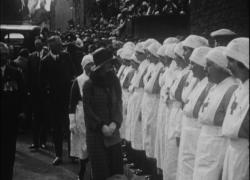
The film opens with a shot of the crowd and officials gathered awaiting the arrival of Amy Johnson. Several planes fly past in an air display. Amy Johnson’s plane lands, and Amy sits on the plane waving to the crowds as she is greeted by the Mayor. She is then presented with a bouquet of flowers by the Mayoress. There are close up shots of the plane |Jason| no. G-AAAH, before it is pushed away by the mechanics. Amy Johnson gives speech from the podium. The film then cuts away to scenes of crowds who line the street to watch the official cars pass. There is also footage of the city streets showing trams. The film ends with shots of an official ceremony with Amy Johnson greeting guests.
Download context pdf
It is not known who made this film, or another film featuring Amy Johnson that the YFA has of Molly Johnson’s Wedding (Amy‘s sister) from 1933; both were donated by Sewerby Hall, which has a collection of Amy Johnson material (see References). The YFA also has film from Gaumont British News, And Hats Off to our Own Record-Breaker Amy Mollinson. British Pathe also has film of Amy Johnson, including a sound film of her arrival back to London from Australia and speech at the airport. They also have film of the Amy Johnson landing at Hedon as seen in this film, Amy’s Homecoming (this film can be viewed on the British Pathe website – see References). In fact a look at Amy’s Homecoming will show the cameraman operating the cine camera that is filming this film! The BFI also has family film of Amy Johnson, including with her later husband Jim Mollinson, also at Hedon Aerodrome.
The film shows Amy Johnson landing at Hedon on 11 August 1930 in the plane she had recently flown single-handedly to Australia, and the civic reception given in her honour in the Guildhall in Hull. As opposed to the Pathe film, this film provides a more intimate picture, and shows much more of the local people and places. It was at this reception that the Amy Johnson Cup was set up. Although you wouldn’t know it from the film, the flight to Hedon was not without its scares. Having only a compass to go by because of low cloud, Amy Johnson descended through the clouds to find open sea. It was only the Spurn Head lights that enabled her to land safely on the beach between the groynes. With the help of the coastguards pulling the plane above the tide line, Amy flew on to Hedon the next day.
The airport had started life in 1888 as a race course, but just prior to World War One it was being used as a landing place by early fliers like Gustav Hamel, who became the first ‘flying postman’. It was later used by Alan Cobhams Flying Circus, and by the time Amy Johnson landed there it was a municipal airport. Although the Government requisitioned the airport during World War Two it was never again used for flying, and by the late 1940s it had become a speedway track.
It was for her flying feats that Amy Johnson became a great celebrity in her lifetime, but she was much more than a world record breaking aeronaut. Amy Johnson was also a pioneer for women to enter hitherto male preserves in other respects too. Already known as something of a ‘tomboy’ at school – she was hit by a cricket ball at the age of fourteen, losing several front teeth – Amy become one of the first women to get a B.A. degree in Economics at Sheffield University, in 1925. She was also the first woman to qualify as a ground engineer, which she passed in December 1929; and for a time was the only woman in the world in possession of a valid Ground Engineer's licence. She also qualified as a navigator. But, not content with doing high profile flying feats, Amy wanted a career in flying, something that she was only able to fulfil through two short lived jobs during the 1930s: as a pilot for the daily London to Paris run for a few weeks in 1934, and another for nine months in 1939 on the Solent air ferry service – thus highlighting the male domination in aviation (which continues still).
Amy has rightly become one of the favourite daughters of Hull, with a memorial statue in Prospect Street. But her grandfather, Anders Jorgensen, was originally an immigrant from Denmark who changed his name to Andrew Johnson when he took British nationality. It was he who started the business that Amy’s father took over in 1914. But Amy’s is not the first famous flight by a person from Yorkshire: that accolade falls on a ten-year-old boy, son of a servant, who became the first person in history to fly when he made a short flight in a glider in Scarborough in 1849. In fact Yorkshire was at the forefront of modern aeronautics as the glider, and various successors, was developed by aeronautical pioneer Sir George Cayley, who lived in Brompton, between Pickering and Scarborough.
Amy herself was born in Hull, at 154 St. George’s Road, on 1st July 1903. Her father was a fish merchant and herring importer, and this was an area where many involved in the fishing industry lived. From there her family moved to various other places in Hull: 241 Boulevard, 48 Alliance Avenue, where they lived for 8 years, and finally 85 Park Avenue where they remained until 1931 when the family moved to Bridlington. She attended Boulevard Secondary School, and after Sheffield University, graduating with a BA, Amy returned to Hull to undertake a secretarial course at Wood's College, on Spring Bank.
A combination of personal problems and a desire to widen her horizons led Amy to move to London in 1927. The previous year she went up in an airplane for the first time, and so enjoyed it that she saved up to join the London Aeroplane Club, and started flying lessons at the de Havilland Aerodrome at Stag Lane, near Edgware, in September 1928. Her first instructor claimed that she would 'never make a flier', but a different instructor was more encouraging and Amy gained her full pilot's licence in July 1929 after 16 lessons – apparently the comedian Will Hay also gave her lessons.
Her enthusiasm for airplanes led her to leave her office to work full-time as a mechanic at Stag Lane. Before long Amy was preparing to break the record time of flying to Australia, of 15 days, as set by Bert Hinker in 1928. Just two weeks before the flight her father was helped by the oil tycoon Lord Wakefield to buy, for £600, a second-hand two-year old De Havilland Moth with a Gipsy engine – a popular sporting plane between the wars – a G-AAAH, she named "Jason", derived from the name of her father’s firm. This is the plane seen in the film: a biplane with an open cockpit, a 9-metre wingspan and a top speed of 90mph. Amy didn’t actually fly it back from Australia herself, but rather took a boat to Egypt before been flown to Croydon by Imperial Airways. It is from here that Amy set off for Hedon. It would be the one and only time that Amy used this plane for any record attempts, being now able to make use of faster planes – it can be seen in the Science Museum, London.
The flight to Australia had been eventful. Having only a flight from Hull to London as long distance experience, Amy set off at 7.45am on the 5th of May 1930, with a thermos flask and a packet of sandwiches. She eventually crash landed at Darwin on 24th May having travelled nearly 11,000 miles. On the way, in torrential rain, fading light and low on petrol, Amy mistook a football field for the runway and crash landed at Insein, just north of Rangoon. This entailed repairs and the delay meant that she failed to break the record. But her solo flight nevertheless brought her huge fame and fortune – £10,000 from the Daily Mail.
Not content with this though Amy Johnson went on to set more records: in July 1931, with Jason II, becoming the first pilot to fly from London to Moscow in one day – 1,760 miles in approximately 21 hours; for Moscow to Tokyo in 10 days in 1931; for Britain to India. Another adveturous woman of that time, Mildred Bruce from Chelmsford Essex, used a locally designed plane, the Balckburn Bluebird - built by Blackburn Aeroplane & Motor Company at Brough (more women pilots of the period can be found on the website: A Fleeting Peace).
Amy gave up flying for records after the disappearance of Amelia Earhart in 1937, during an attempted round-the-world flight. Amelia Earhart (coincidentally also known as ‘Amy’) was Johnson’s US rival, and possible inspiration, who had become the first woman to fly across the Atlantic Ocean in June 1928. Amy Johnson was right to be wary as she suffered a similar fate to Amelia Earhart’s just four years later. With the outbreak of war Amy joined the newly formed ATA (Air Transport Auxiliary) in May 1940. A women’s section of the ATA had been established in January 1940 by another woman pilot, Pauline Gower. One of their jobs was to transport Royal Airforce planes around the country – women not being allowed to fly in combat. It was on one such mission that Amy drowned in the Thames Estuary.
On 5th January 1941 Amy Johnson took off in thick, freezing fog from Blackpool airport to deliver an aeroplane to an RAF base in Kidlington, Oxfordshire. There has been much speculation as to how an experienced pilot such as Amy could have found herself so lost and running out of fuel. But in all likelihood she had to stay above cloud level, and with no other means of navigation, in order to prevent ice build up on the windows. Thinking she was over land Amy bailed out and landed in the water. Although spotted alive by HNS Haslemere she was sucked under by the boat despite the efforts of Lieutenant Commander Walter Fletcher, who dived into the icy waters after her, and who himself died of hypothermia in the rescue attempt. Her body was never found.
As well as being awarded the CBE, Amy also received: the Egyptian gold medal for valour (1930), the women’s trophy of the International League of Aviators (1930), the President’s gold medal of the Society of Engineers (1931), the Segrave Trophy (1933), the gold medal of honour of the League of Youth (1933), and the gold medal of the Royal Aero Club (1936). In 1942 a film was made of Amy Johnson's life, They Flew Alone, starring Anna Neagle as Johnson, and Robert Newton as Mollison. The British Women Pilot's Association continues to uphold her name through an annual Amy Johnson Memorial Trust Scholarship which helps outstanding women pilots further their careers.
References
The Hull Local Studies library has a large collection of material relating to Amy Johnson. On their website can be found a very useful summary of her life with a comprehensive bibliography and list of other source materials: historycentrehull
Constance Babington Smith, Amy Johnson, Collins, London, 1967
Judy Lomax, Women of the Air: Amy Johnson, British Heroine from Hull, John Murray Ltd, London, 1986
Roy Nesbit, ‘What did happen to Amy Johnson?’, Aeroplane Monthly, January, 1988
Robb Robinson, Far Horizons: from Hull to the ends of the Earth, Maritime Historical Studies Centre University of Hull, 2010.
Gordon Snell, Amy Johnson, Queen of the Air, Hodder and Stoughton, London, 1980
Gordon Snell, Amy Johnson, Queen of the Air, Hodder and Stoughton, London, 1980
The Amy Johnson Collection at Sewerby Hall:
International organisation of women pilots: The Ninety-Nines
Further Information
Charles Dixon, Amy Johnson - Lone Girl Flyer, Sampson Low, London, 1930
Liz Moscrop and Sanjay Rampal, The 100 Greatest Women in Aviation, Aerocomm, 2008.
Rosanne Welch, Encyclopaedia of Women in Aviation and Space, Oxford: ABC-CLIO, 1998
Kingston upon Hull City Council, Silvered Wings, A Commemorative Brochure, Kingston upon Hull City Council, 1980
Yorkshire Post , ‘Amy Johnson 50th anniversary supplement’, May 19th 1980.
Duration:
6 mins 34 secs of 7 mins |
 16mm |
 Silent |
 Black & White |
This film is an extract. To access the complete film please contact the Yorkshire Film Archive
Explore More
Discover more films from the YFA collections...



1 Comment
Attached are two images of a programme/menu for a lunch in honour of Amy Johnson given in August 1930 after her flight to Australia. The items are in the Hohenrein collection of the Hull History Centre
Post new comment